

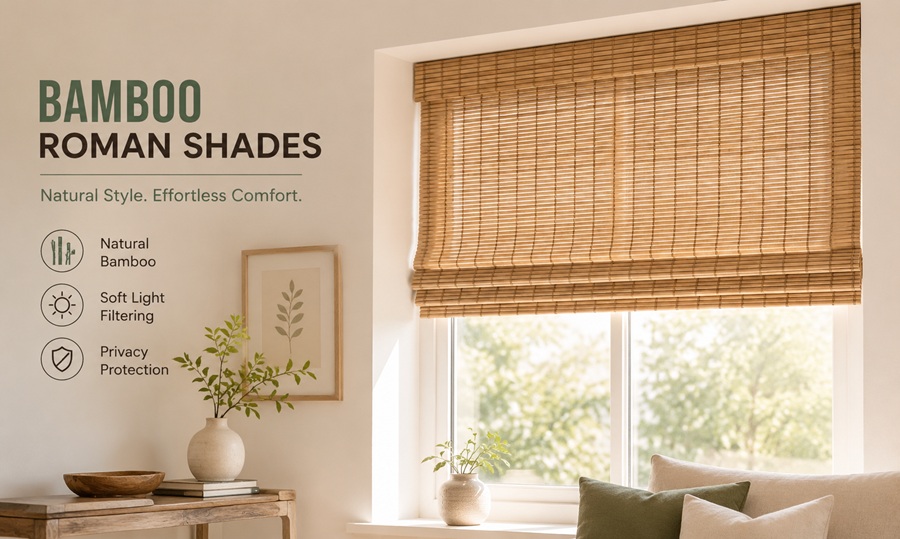
Bamboo roman shades typically cost $40–$120 per window for standard sizes off the shelf, or $150–$400 per window for custom-fit options, with the price driven mainly by width, lining choice, and whether the shade is cordless. They bring warm, natural texture that fabric or vinyl shades can’t replicate, though they filter light rather than fully blocking it unless a blackout lining is added. Here’s what drives the cost, what options are worth considering, and where these shades work best in a home.

Cost Breakdown
Pricing depends on size, lining, and whether the shade is a stock size or custom-ordered:
- Stock/off-the-shelf sizes: $40–$120 per shade, typically available in standard widths like 23, 35, or 47 inches.
- Custom-sized shades: $150–$400 per shade, made to the exact window measurement, which matters most for non-standard or oversized windows.
- Lined shades (light-filtering to blackout): add $30–$80 per shade over an unlined version, depending on lining thickness.
- Cordless or motorized lift mechanisms: add $20–$150 per shade, with motorized options at the top of that range.
Options to Consider
Lined vs. unlined is the first major decision. Unlined bamboo shades let in a soft, filtered light and a visible silhouette from outside, which suits rooms where privacy isn’t the top priority. Lined versions add a fabric backing that improves privacy and can range from light-filtering to full blackout, at the cost of some of the natural texture showing through from outside.
Cordless vs. corded lift systems matter most for households with kids or pets, where dangling cords are a safety concern — cordless spring-lift systems have become the standard recommendation for any bedroom or nursery. Motorized shades add convenience and work well paired with smart home systems, though they’re the most expensive option and require either a battery or a nearby outlet.
Mount type — inside mount (fits within the window frame) versus outside mount (mounted on the wall or trim around the window) — affects both the finished look and how much light leaks around the edges. Outside mount typically blocks more light at the edges and works better for windows with shallow frames that can’t fit an inside-mounted shade.
Recommendations by Room
Living rooms and dining rooms suit unlined or light-filtering bamboo shades well, since the natural texture pairs with a wide range of decor styles and full blackout usually isn’t necessary. Bedrooms do better with a lined version, ideally paired with cordless lift for safety, especially in homes with young children.
Bamboo shades also pair naturally with other window treatments — many homeowners layer them under curtains or drapes, using the shade for daytime light control and the curtains for evening privacy or blackout needs.
Bamboo Shades vs. Woven Wood Shades
The terms bamboo shades and woven wood shades are often used interchangeably, but there’s a real distinction worth knowing before buying. Bamboo shades are made specifically from bamboo reeds or strips, giving them a lighter color and a more uniform, closely woven texture. Woven wood shades is a broader category that includes bamboo along with other natural materials like jute, rattan, and grasses, often combined in a single shade for a more varied, textured look.
Neither is inherently better — bamboo tends to give a cleaner, more consistent look that suits transitional and coastal styles, while mixed woven wood shades bring more texture variation that fits well in bohemian or rustic-leaning rooms. Pricing between the two is generally comparable, so the decision usually comes down to preferred texture rather than cost.
Maintenance and Longevity
With regular light dusting and occasional spot cleaning, bamboo roman shades typically last 7 to 15 years before the material starts to show wear, fading, or minor warping. Keeping them away from direct, prolonged moisture — steamy bathrooms or unshielded outdoor exposure — is the single biggest factor in extending that lifespan, since bamboo is a natural material that responds to sustained humidity the way untreated wood does.
Rotating the shade’s exposure to direct sun when possible, or adding a UV-protective window film, can also slow fading over time, particularly for shades on south- or west-facing windows that see the most direct afternoon light.
Pairing Bamboo Shades With Other Decor
Bamboo shades work particularly well in rooms that already lean toward natural materials — wood furniture, woven baskets, linen upholstery — since the shade’s texture reinforces rather than competes with that palette. In rooms with a more polished or formal look, bamboo shades can still work well, but they read best paired with at least one other natural or textured element in the room, like a jute rug or a wood coffee table, rather than standing alone against an otherwise fully upholstered, glossy, or metallic space.
Color-wise, bamboo shades range from very light, blonde tones to darker, more amber or espresso-stained finishes. Lighter tones tend to brighten a room and suit coastal or Scandinavian-influenced spaces, while darker tones add warmth and work well in rooms with deeper, more saturated wall colors.
Ordering and Measuring Tips
For inside-mount installations, measure the width at three points — top, middle, and bottom of the window opening — and use the narrowest measurement to ensure the shade fits without binding against the frame. For outside-mount installations, add at least 2 to 3 inches of width beyond the window frame on each side to improve light blocking and privacy at the edges. Double-checking measurements before ordering matters more with bamboo shades than with some other window treatments, since natural material doesn’t trim down or adjust as easily as fabric once it arrives.
Frequently Asked Questions
Are Bamboo Roman Shades Good for Privacy?
Unlined bamboo shades offer only partial privacy, since the woven material still allows a visible silhouette, especially at night with interior lights on. Adding a fabric lining significantly improves privacy and is the recommended option for bedrooms, bathrooms, or any street-facing window.
How Much Do Custom Bamboo Shades Cost?
Custom bamboo roman shades typically run $150 to $400 per window depending on width, lining, and lift mechanism, compared to $40 to $120 for standard stock sizes. The added cost usually pays off for oversized or unusually shaped windows where stock sizes wouldn’t fit properly.