

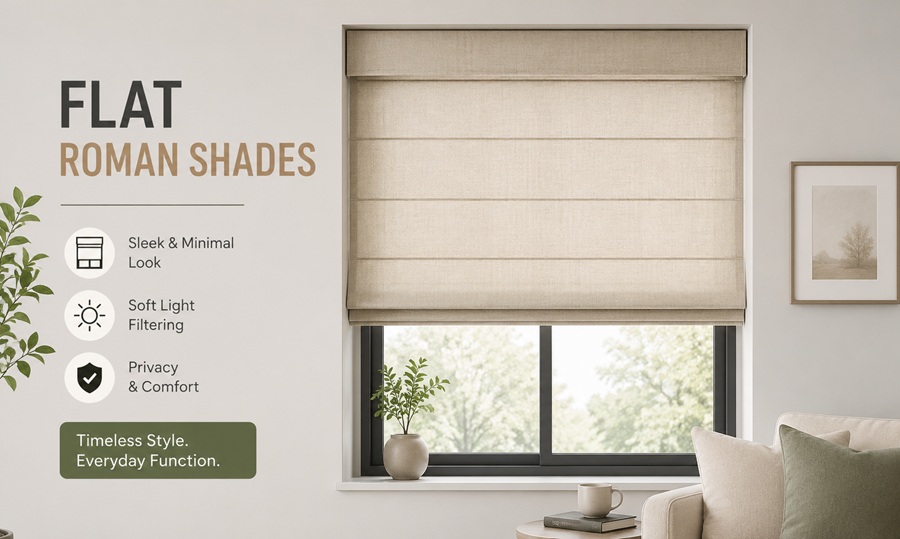
Flat roman shades fold into clean, crisp horizontal panels when raised, giving windows a tailored, architectural look that suits modern and minimalist interiors. This sets them apart from hobbled roman shades, which stack into soft, rounded folds even when lowered, and relaxed roman shades, which dip gently at the bottom for a more casual, draped look. Choosing between the three comes down to how formal or relaxed the room feels and how the window is used day to day.

Where Flat Roman Shades Are Typically Used
Flat roman shades show up most often in modern, minimalist, and transitional interiors, where clean lines and a lack of excess fabric fit the room’s overall restraint. They’re a common pick for home offices, kitchens, and living rooms where a simpler, less fussy window treatment complements furniture that’s already fairly streamlined.
Because the fabric lies smooth against the window even when lowered, flat roman shades also work well as a backdrop for other design elements — patterned fabric reads more clearly on a flat surface than on a shade with folds and shadows already built into its shape.
Comparison: Flat vs. Hobbled vs. Relaxed
Flat roman shades hang smooth and taut when lowered, with horizontal folds appearing only as the shade is raised, stacking into neat, structured pleats at the top. This makes them best suited to solid or subtly patterned fabrics, since the flat surface shows off a print without visual interruption, and to windows where a tailored, precise look is the goal.
Hobbled roman shades keep soft, rounded folds cascading down the shade even when fully lowered, giving a more traditional, textured look. They tend to work best in formal living rooms or dining rooms where a slightly more decorative window treatment fits the room’s overall style.
Relaxed roman shades have a soft dip or scallop at the bottom edge, giving them the most casual, lived-in look of the three. They suit farmhouse, coastal, or cottage-style interiors and rooms where a slightly imperfect, draped look is the intended effect rather than precision.
Expert Advice: Fabric and Lining Choices
For flat roman shades specifically, mid-weight cotton, linen blends, or light performance fabrics hold their shape best without sagging in the middle over time. Heavier fabrics like velvet can work but need proper interlining to prevent the shade from looking wavy or uneven when lowered.
Lining matters for both function and structure. A basic cotton lining adds body to the fabric and helps the shade fold crisply, while a blackout or thermal lining adds light control and insulation at the cost of some flexibility in how tightly the shade folds. For rooms where precise, sharp folds matter most — a home office or a formal dining room, for example — professional-grade interlining is worth the added cost over a standard lining.
Flat Roman Shades vs. Curtains
Flat roman shades and curtains solve similar problems — privacy and light control — but with a distinctly different visual result. Roman shades sit flush against the window frame and take up minimal visual space when raised, which suits smaller rooms or windows where curtain panels would feel bulky or eat into limited wall space nearby. Curtains, by contrast, add softness and drape to a room and are easier to layer with sheers for flexible daytime light control.
Many rooms use both together — a flat roman shade for precise light and privacy control close to the glass, paired with curtain panels on the outside for added softness and a more finished, layered window treatment. This combination is especially common in living rooms and primary bedrooms where both function and a more decorated look matter.
Sizing and Mounting Considerations
Flat roman shades can be mounted inside the window frame for a clean, built-in look, or outside the frame on the surrounding wall or trim for a design that covers more of the window opening and blocks more light at the edges. Inside mount requires a frame with enough depth to accommodate the shade’s hardware, typically at least 2.5 inches, while outside mount works on virtually any window regardless of frame depth.
For width, custom sizing is almost always worth it for flat roman shades specifically, since even small gaps at the sides are more visible on a flat, taut fabric surface than they would be on a gathered curtain panel. A shade that’s slightly too narrow for its inside-mount opening will show noticeable light gaps on both sides, undermining the tailored look that makes this style appealing in the first place.
Color and Pattern Choices
Because flat roman shades present fabric as a single smooth plane rather than in folds or gathers, they show off pattern more clearly than most other window treatment styles — a striped or geometric fabric reads crisply and evenly across the flat surface, without the visual interruption that folds create on hobbled or relaxed styles. This makes flat roman shades a strong choice for anyone wanting to introduce a bolder pattern into a room without it looking chaotic.
Solid colors work equally well and tend to be the more common choice in modern and minimalist spaces, where the shade’s clean silhouette and folding mechanism are meant to be the visual interest rather than a printed pattern. Neutral tones — soft white, greige, warm taupe — remain the most popular choice for flat roman shades since they blend into a room’s existing palette rather than demanding attention.
Cost Expectations
Flat roman shades typically run $60 to $150 per window for stock or semi-custom options in standard fabrics, and $150 to $350 or more for fully custom sizing, premium fabric, and professional lining. The final cost depends heavily on fabric choice — a basic cotton runs toward the lower end, while designer fabric, silk blends, or heavier interlined constructions push costs toward the higher end of the range.
Frequently Asked Questions
What’s the Difference Between Flat and Hobbled Roman Shades?
Flat roman shades lie smooth and taut against the window when lowered, only forming folds as they’re raised, while hobbled roman shades keep soft, rounded folds visible down the shade’s length even when fully lowered. The difference comes down to how the fabric is sewn and lined during construction, not the fabric itself — the same fabric can be made into either style.
Do Flat Roman Shades Need Lining?
Lining isn’t strictly required, but it’s recommended for flat roman shades since it helps the fabric hang smooth and fold cleanly rather than sagging or wrinkling over time. Unlined flat shades in lightweight fabric are more prone to an uneven, rippled look, especially on wider windows.