

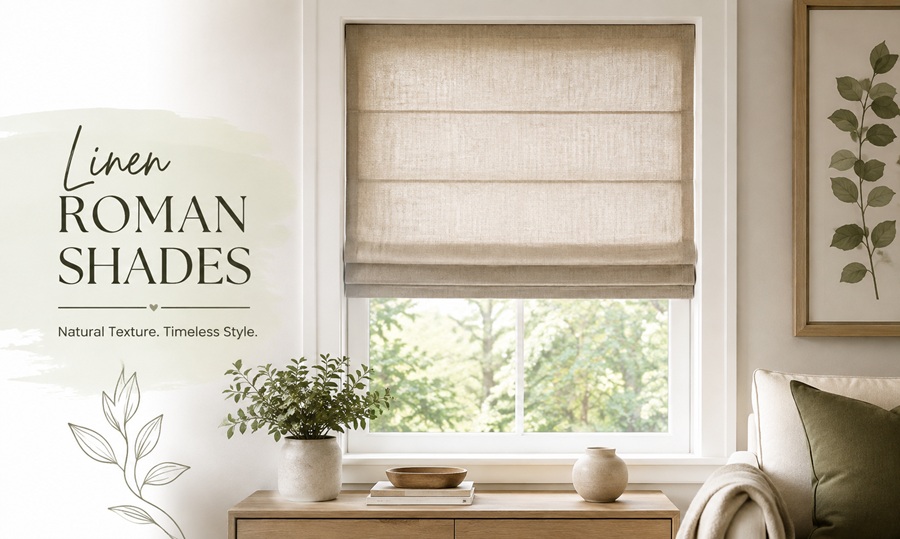
There’s a reason linen roman shades show up in nearly every designer’s window-treatment shortlist. The fabric has a natural texture that softens a room without competing with anything else in it, and the fold structure of a roman shade gives it a tailored look that flat panel curtains rarely achieve.

Why Linen Specifically
Cotton and synthetic blends can look flat under direct light, while linen has a natural slub and weave variation that catches light differently throughout the day. That texture is part of why linen roman shades read as more expensive and considered than most alternatives, even at a comparable price point.
Fold Styles: Which One Fits Your Window
Flat Fold
A flat fold roman shade lies smooth against the window when lowered, with folds appearing only as it’s raised. This style suits modern or minimalist rooms where a clean, unbroken fabric surface matters more than texture.
Hobbled (Soft) Fold
Hobbled shades keep a soft, cascading fold even when fully lowered, giving the window a more traditional, layered look. This style tends to use more fabric and costs slightly more as a result.
Relaxed Roman Shade
Relaxed shades have a gentle curve at the bottom hem rather than a crisp straight edge, giving them a softer, more casual feel that pairs well with linen’s natural texture.
| Fold Style | Look | Best Room Type |
|---|---|---|
| Flat fold | Clean, tailored | Modern, minimalist spaces |
| Hobbled fold | Layered, traditional | Formal living rooms, dining rooms |
| Relaxed fold | Soft, casual | Bedrooms, cottage-style interiors |
Lining Options and What They Actually Change
- Unlined: maximum light filtering, softest look, least privacy at night
- Privacy lining: blocks visibility from outside while still allowing some light through
- Blackout lining: nearly full light block, best for bedrooms and media rooms
- Thermal lining: adds insulation value, useful in rooms with significant window heat loss
| Note: Unlined linen shades will show silhouettes from outside at night once interior lights are on. If privacy matters, budget for at least a basic privacy lining. |
Measuring for Inside vs. Outside Mount
- Decide between an inside mount, which sits within the window frame, or an outside mount, which covers the frame entirely
- For inside mount, measure the exact width of the window opening at three points and use the narrowest measurement
- For outside mount, add 2 to 3 inches of overlap on each side beyond the frame
- Measure height from the top of the mounting point to the sill or desired stopping point
- Round down for inside mount width and up for outside mount width to avoid gaps
Caring for Linen Shades
Linen is durable but prone to wrinkling and sun fading over time. Regular dusting with a vacuum brush attachment prevents buildup that eventually dulls the fabric’s color, and rotating shades between rooms occasionally helps distribute sun exposure more evenly.
- Vacuum gently with a brush attachment every few weeks
- Spot clean stains immediately with a mild fabric cleaner, never a harsh solvent
- Avoid machine washing, which can shrink or warp the fold structure permanently
- Consider UV-protective window film in rooms with intense afternoon sun exposure
Budget Expectations
| Option | Approximate Cost per Window |
|---|---|
| Ready-made, unlined | $60–$120 |
| Ready-made, lined | $100–$180 |
| Custom, unlined | $150–$250 |
| Custom, lined (blackout) | $220–$350 |
Frequently Asked Questions
Do linen roman shades block out light completely?
Not without a blackout lining. Unlined linen naturally filters light rather than blocking it, which is part of its appeal in living spaces but a drawback for bedrooms.
Will linen shades shrink or warp over time?
Quality linen shades are typically pre-treated to resist shrinkage, but avoiding machine washing and excessive humidity exposure helps maintain the fold structure long term.
Are linen roman shades a good choice for bathrooms or kitchens?
Generally no, since linen absorbs moisture and odors more readily than synthetic blends, faux wood blinds or vinyl shades tend to hold up better in high-humidity rooms.
How do I clean a linen roman shade without taking it down?
Regular vacuuming with a soft brush attachment handles dust, and spot cleaning with a mild detergent works for small stains without needing to remove the shade.
What’s the price difference between ready-made and custom shades?
Custom shades typically run 50 to 100 percent more than ready-made options, but they offer an exact fit and more control over fold style, lining, and fabric weight.
Linen roman shades sit in a nice middle ground between the softness of curtains and the structure of blinds. Choose your fold style based on the room’s formality, decide on lining based on privacy needs, and measure carefully, and they tend to be a window treatment you won’t feel the need to replace for years.